

Mawhiba Level 2 Study Plan: What to Do by Days Left
A plan for parents by time left: more than 4 weeks, two to three weeks, the last week, the day before and test day, built on 75 seconds per question and 96 questions in 120 minutes.
- Next test
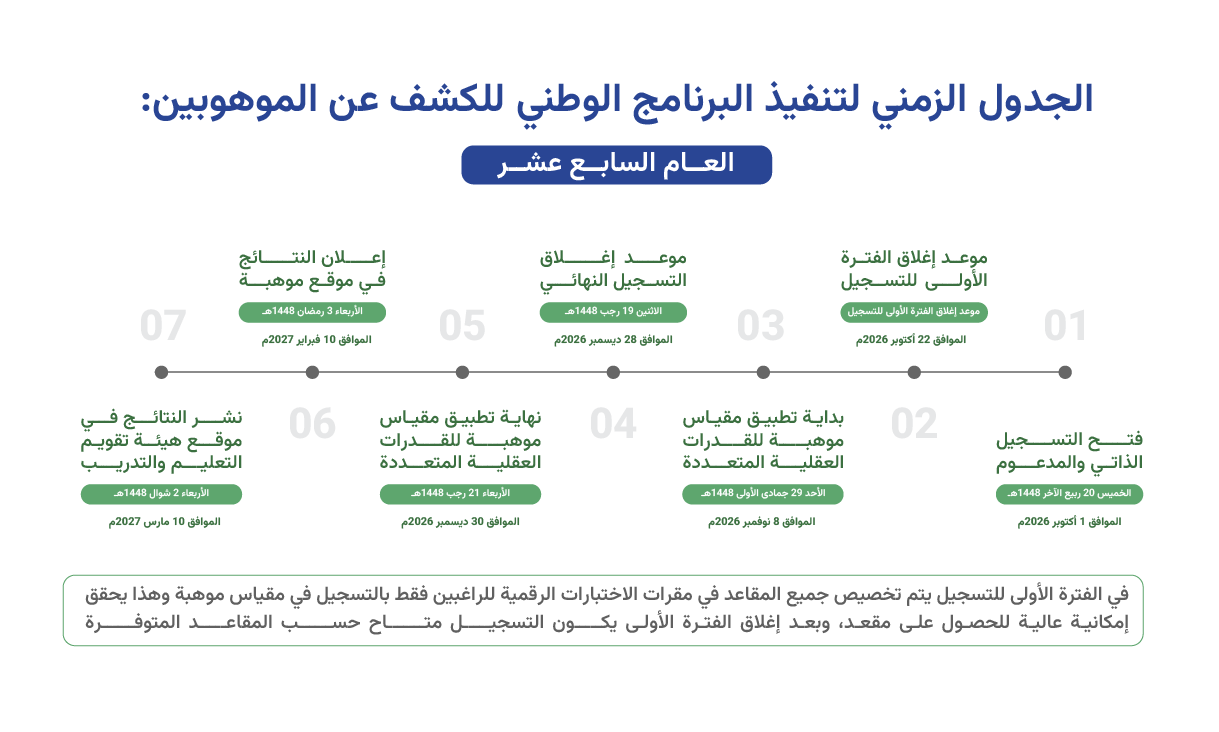
- 8 November – 30 December 2026 Add the date to your calendar
- Questions and time
- 96 questions · 120 minutes
- Pass mark
- No pass mark; the score runs from 1000 to 2000 and decides which programs the student qualifies for
- Exam fee
- SAR 200 for self-nominated students; students with supported (school) nomination are exempt
Start with 10 free questions to find what needs more work. No sign-up, with answer explanations.
Try 10 free questions and see your levelPut what you just read into practice
Start with 10 free questions to find what needs more work. No sign-up, with answer explanations.
Try 10 free questions and see your levelLast checked: 1 November 2026. The numbers in this plan come from the National Program for Gifted Identification page on Mawhiba's website and from the 17th-year timeline. They can change, so check them before the test. This is an independent guide, not affiliated with the Mawhiba foundation, the Education and Training Evaluation Commission or any government body.
Your child gets one attempt at Level 2, and that may lead some parents to push their children. This plan works the other way round: short sessions, a clear goal each week, and practice at sharing time. The syllabus guide explains the four domains and the question types, and the scores guide covers what comes after the test.
The numbers behind the plan
| Item | Number | What it means for practice |
|---|---|---|
| Questions | 96 multiple-choice questions | Across the four domains; in our mock exams, 24 questions per domain |
| Time | 120 minutes | 75 seconds per question on average (120 × 60 ÷ 96) |
| Time per domain | About 30 minutes | 24 questions × 75 seconds; a set of 12 questions takes 15 minutes |
| Test dates | 8 November to 30 December 2026 | Count the weeks from the date your child chose at registration |
| Registration | Until 28 December 2026 on the Sadeed platform | The first phase closed on 22 October; after that seats depend on availability |
First step for any amount of time: ten free questions
Before any timetable, sit with your child at the free practice test: ten free questions, no sign-up, covering the four domains. The result is split by domain so you see the weakest one, and every option is explained. Comment on the score in one sentence at most, such as "now we know where to start". This result is for practice only and is not a Mawhiba score.
If the result comes out close across the four domains, start with the domain your child complains about most, then the one where they run over time: a domain that takes more than 75 seconds a question deserves a timed session early. If one domain scores much lower than the rest, make it the focus of the first and second weeks before any other.
What a 30-minute session looks like
- 5 minutes: review two or three questions from "My mistakes", with your child saying out loud why they chose the wrong option last time.
- 15 minutes: 12 questions from one domain against a timer, which is 75 seconds a question. Your child skips the hard question and comes back to it.
- 10 minutes: read the explanation of every question they got wrong, or got right by guessing. A right answer without understanding cannot be relied on in the test.
End the session with one sentence about something your child did well today. Long introductions and explaining every concept in one sitting tire a child and take time from the practice itself.
If more than 4 weeks are left
- Week 1, the weakest domain: four sessions of 25 to 30 minutes. Read the domain's study notes with your child in the practice area, then do 10 questions together with no timer, reading the explanation of every option, right and wrong.
- Weeks 2 and 3, the other domains: about four days per domain. The questions your child gets wrong are in "My mistakes", so read them at the start of the next session.
- Week 4, timing: sets of 12 questions in 15 minutes, then 24 questions in 30 minutes. The aim is for your child to get used to an average of 75 seconds per question.
- End of week 4: a full mock exam of 96 questions in 120 minutes in one sitting. Afterwards, look at the weakest domain in the score and at the questions in "My mistakes".
If two to three weeks are left
- Days 1 to 3: the ten free questions, then a set of 10 questions in each domain from "Weak points".
- Rest of week 1: three quarters of the time on the two weakest domains and the last quarter on the other two, so your child does not forget what they know.
- Week 2: timed sets of 24 questions in 30 minutes, one domain per session, with "My mistakes" at the start of each session.
- About five days before the test: one full mock exam, then two days to review what went wrong.
In the last week
- No new material. Go through flashcards and "My mistakes" for 15 to 20 minutes a day.
- One timed set of 24 questions on day 1 and day 3, from the domain that is still weakest.
- If your child has not tried a full mock yet, give it the first two days of the week, not the night before the test.
- Practise one rule: if two and a half minutes pass on a question and the way forward is still unclear, your child flags it and moves on, then returns at the end. A question that takes two and a half minutes eats the time of two others.
The day before
- A light session: ten minutes of flashcards and no mock exam.
- Have the student's proof of identity ready: the Sadeed registration guidance advises arriving at the centre well before the appointment with proof of identity.
- Check the test date and centre in the student's account on the Sadeed platform, and that the registered grade is your child's actual grade.
- An early night and the usual breakfast.
On test day
- Leave early so your child does not walk into the room in a rush.
- The test is computer-based at the test centre: 96 questions in 120 minutes. Remind your child of the rule: a stuck question is flagged and left, and in the last ten minutes they return to the flagged ones.
- Afterwards, do not go through the answers question by question. Mawhiba announces results on its website on 10 February 2027, and asking now will not change them.
How to ease the pressure on your child
- Keep practice to short sessions of 25 to 30 minutes, and stop if your child is tired after 15.
- Ask your child to explain how they solved one question instead of reviewing all of them. A child who can explain a method remembers it in the test.
- Do not compare your child with others. The weighted score is calculated differently for each grade.
- Remember what Mawhiba says: a student who does not reach the required score in a given year can sit the test at the next level and can take part in Mawhiba's competitions. Details are in the scores guide.
The site's tools in the plan
The ten free questions and the free practice test need no sign-up. In the practice area you get practice by domain, weak points, My mistakes, flashcards and the full mock exam (with paid access). For more on the test, see the Mawhiba Level 2 page.
Finished reading? Try a set of questions
Start with 10 free questions to find your weakest units. Keep practising with the full question bank and mock exams from SAR 26.