

Mawhiba Level 2 Score: 1000 to 2000 and What It Means
How the Mawhiba Level 2 score works: 1000 to 2000, a weighted score per grade, the three gifted classifications, the programs a score leads to, and what to do if it falls short.
- Next test
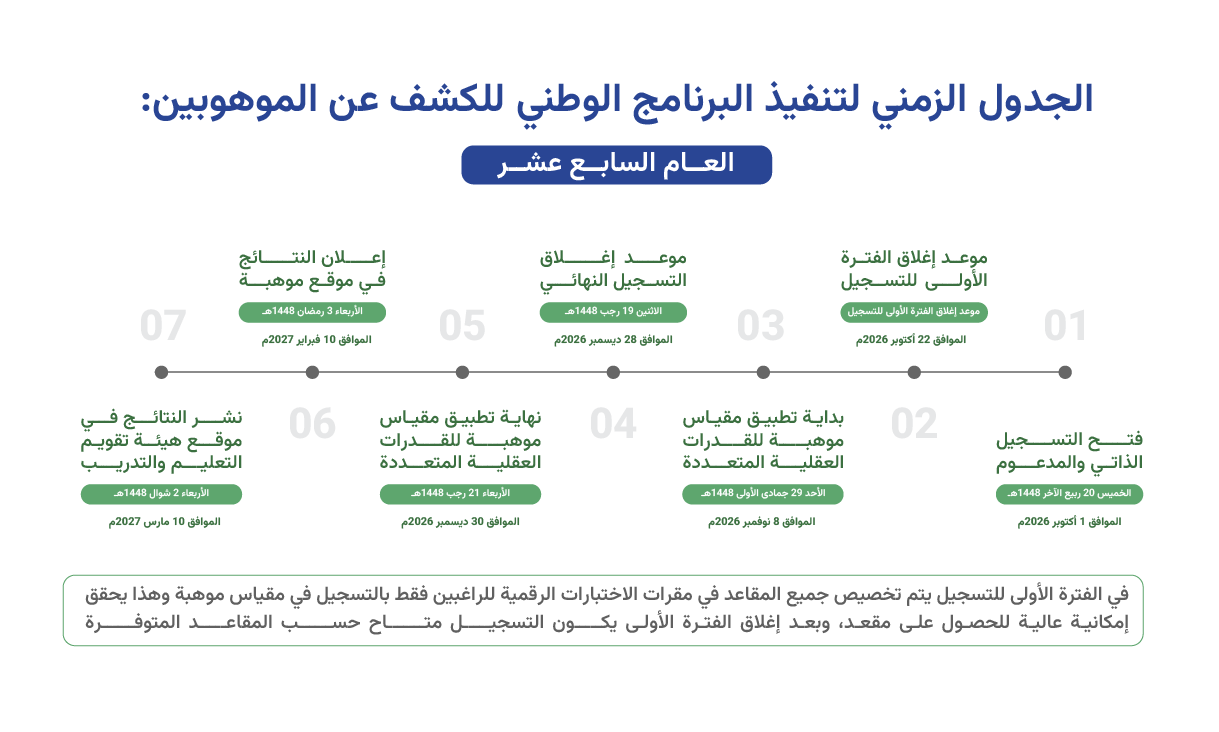
- 8 November – 30 December 2026 Add the date to your calendar
- Questions and time
- 96 questions · 120 minutes
- Pass mark
- No pass mark; the score runs from 1000 to 2000 and decides which programs the student qualifies for
- Exam fee
- SAR 200 for self-nominated students; students with supported (school) nomination are exempt
Start with 10 free questions to find what needs more work. No sign-up, with answer explanations.
Try 10 free questions and see your levelPut what you just read into practice
Start with 10 free questions to find what needs more work. No sign-up, with answer explanations.
Try 10 free questions and see your levelLast checked: 1 November 2026. What this guide says about the score, the classifications and the programs comes from the National Program for Gifted Identification page on Mawhiba's website, and the result dates from the 17th-year timeline. They can change, so check them before the test. This is an independent guide, not affiliated with the Mawhiba foundation, the Education and Training Evaluation Commission or any government body.
The first question parents ask after registering is how many points their child needs. The answer is that the Mawhiba test does not set a single pass mark. This guide explains how the score is calculated, what the three gifted classifications mean, where a score leads, and what your child can do if they do not reach the score a program asks for. For what the test measures, see the syllabus guide, and for training see the study plan guide.
A score from 1000 to 2000
Scores run from 1000 to 2000. There is no general pass mark: each Mawhiba program sets its own qualifying score, which you find on the program's page on Mawhiba's website. The same score can qualify your child for one program and not for another.
A weighted score for each grade
Level 2 has one form for students in grade 6 (primary) and grades 1 and 2 (intermediate), but the way the score is calculated differs from grade to grade, so the weighted score is different for each grade. Mawhiba says the aim is to remove the effect of age from the result. In practice, a child in grade 6 is not compared with a child in intermediate grade 2 on the number of correct answers alone.
That is why a student must be registered in their actual school grade. Mawhiba says that sitting the test in a grade other than the student's own cancels the score, and that the student carries that responsibility under the program's policy.
The score is not just the number of correct answers
According to the FAQ Mawhiba published for the test in 2020, the score is built on a statistical assessment method that takes into account the difficulty of each question, not only the number of correct answers. This means two correct answers may not carry the same value. For that reason this site does not offer a table that converts correct answers into a score.
What the score means on our site
Your score in our mock exams is the percentage of correct answers, split across the four domains: Verbal Reasoning and Reading Comprehension, Mathematical and Spatial Reasoning, Scientific and Mechanical Reasoning, and Mental Flexibility. It lets you see where your child loses marks. It is for practice only, it is not a Mawhiba score, and it does not convert into a number between 1000 and 2000.
The three gifted classifications
Mawhiba classes qualifying students into three groups, each described by abstract reasoning ability compared with peers:
- Exceptionally gifted: exceptional abstract reasoning compared with gifted peers, shown in producing varied and unique ideas, linking observed phenomena to experimental data to predict logical results, and justifying with arguments and evidence.
- Gifted: high abstract reasoning compared with peers, shown in generating and testing multiple ideas and options, and reaching conclusions and solutions through specific strategies and justifying them logically.
- Promising: abstract reasoning that can be developed, compared with peers, shown in how the student approaches things and situations by analysing their difficulty and using it to make decisions and offer solutions.
Where the score leads
Mawhiba says the score a student earns determines the type of program, and that the student chooses what suits them among the programs available if they meet the registration conditions. Students are directed to the programs they qualify for based on their score. Programs the page mentions include:
- Mawhiba enrichment programs.
- Mawhiba classes.
- The Mawhiba advanced program in science and mathematics.
- The Mawhiba program for admission to prestigious universities.
- Programs offered by the Ministry of Education, and programs and services from partner organisations that support gifted students.
A student can be accepted into more than one program if their dates do not clash. Each program has its own criteria and conditions, so check each program's page on Mawhiba's website before building an expectation on a particular score. Some programs, such as the Mawhiba global enrichment program and the Mawhiba ambassadors program, require a qualifying English score as well as the test score.
How long the score stays valid
The score stays valid until the student moves up to a new level of the test. A student can sit the test only once per level, whatever the test language: a student who sat it in English cannot retake it next year in Arabic.
When the result comes out
According to the 17th-year timeline, the test runs from 8 November to 30 December 2026, and results are announced on the Mawhiba website on 10 February 2027 and published on ETEC's website on 10 March 2027. The result appears in the student's record on the Mawhiba website.
How to read the result when it arrives
Open the student's record on Mawhiba's website, then open the page of each program that interests your child and compare their score with the qualifying score written there. Do not compare your child's score with a relative's in another grade, since the weighted score is calculated differently for each grade. If the gap between the score and what a program asks for is large, read the next section before you judge the situation.
If your child does not reach the score a program asks for
- The next level: Mawhiba says the student can sit the test at the next level. Level 3 is for students in intermediate grade 3 and secondary grade 1.
- Competitions: they can take part in Mawhiba's competitions, including the national olympiad for scientific creativity (Ibdaa), the Mawhoob competition, Kangaroo Mawhiba and Bebras Mawhiba.
- Other programs: according to Mawhiba, missing the required score in one year does not mean the student cannot benefit from its programs.
What to do now
Register your child in their actual grade, start with the ten free questions to see which of the four domains is weakest, then spread practice according to the time left. A few days before the test, try a full mock exam of 96 questions in 120 minutes. Fees and nomination details are on the Mawhiba Level 2 page.
Finished reading? Try a set of questions
Start with 10 free questions to find your weakest units. Keep practising with the full question bank and mock exams from SAR 26.
Sources and references
- موهبة: البرنامج الوطني للكشف عن الموهوبين (الدرجة 1000 إلى 2000، التصنيف، الصلاحية، البرامج، الأسئلة الشائعة) mawhiba.sa
- موهبة: الجدول الزمني لتنفيذ البرنامج الوطني للكشف عن الموهوبين، العام السابع عشر (مواعيد النتائج) mawhiba.sa
- موهبة: خدمة البرنامج الوطني للكشف عن الموهوبين (الرسوم والتسجيل) mawhiba.sa