CEPT – English Proficiency Test for Children: free practice test
Start with 10 free questions to see what needs more practice. Finish to see your score, weakest units and every option explained.
Practice test questions with answers and explanations
Try the questions in the test above first, then open each one here to see the correct answer and why every other option is wrong.
01What size cup does the girl finally choose?
Transcript
Man: Hello! What would you like today?
Girl: Hi. I would like one orange juice, please.
Man: One orange juice. Do you want a small or a big cup?
Girl: A big cup, please. How much is it?
Man: A big orange juice is eight riyals.
Girl: Oh, wait. Eight riyals? Then I want a small cup. Small is six riyals, right?
Man: Yes, that is correct. Six riyals for a small cup.
Girl: Okay. Here is ten riyals. Thank you.
Man: Thank you. Here is your change, four riyals. Have a nice day!
Reference: Council of Europe (2018), Collated Representative Samples of Descriptors of Language Competences Developed for Young Learners, Vol. 1 (ages 7–10): Understanding conversation between other speakers, A1, p. 25
02What time do the children go to the library today?
Transcript
Good morning, class. Please listen carefully. It is time to tidy up.
First, put your pencils in the blue box. Then close your books.
Next, take your bag from under the desk. Put it on the hook by the door.
Do not leave your pens on the floor. Please pick them up now.
After that, wash your hands at the sink. Then line up quietly.
Oh, wait. We go to the library at ten o'clock. No, sorry. It is at eleven o'clock today.
Reference: Council of Europe (2018), Collated Representative Samples of Descriptors of Language Competences Developed for Young Learners, Vol. 1 (ages 7–10): Overall listening comprehension, A1, p. 24
03Why might Fluffy have stayed away from home?
Transcript
Girl: Omar, have you seen our cat, Fluffy? She is not in the garden.
Boy: No, I have not, Noura. When did you last see her?
Girl: This morning, at eight o'clock. She was sleeping on the warm mat.
Boy: Then we went to school all day, and I came home at three.
Girl: I came home at one, and the back gate was open. Fluffy was gone.
Boy: Oh no. I feel very sad. Maybe she is hungry.
Girl: Her food bowl is still full. Maybe she is scared of the birds in the garden.
Boy: Let's look on the street first. Then we will ask Grandma.
Girl: Good idea. I hope we find her before dinner.
Boy: Me too! Let's go now.
Reference: Council of Europe (2018), Collated Representative Samples of Descriptors of Language Competences Developed for Young Learners, Vol. 1 (ages 7–10): Understanding conversation between other speakers, A1, p. 25
04Why does the mother say the boy by the palm tree is not Omar?
Transcript
Woman: Excuse me, I am looking for my son, Omar.
Man: What does he look like?
Woman: He is tall, with short black hair. He is wearing a blue T-shirt and white shorts.
Man: Does he wear glasses?
Woman: Yes, round glasses. He is holding a red football.
Man: I saw a boy with a football by the palm tree. He wore a yellow T-shirt.
Woman: That is not Omar. Omar's T-shirt is blue. Maybe he is by the fountain.
Man: Let's check the fountain together.
Woman: Thank you. You are very kind.
Reference: Council of Europe (2018), Collated Representative Samples of Descriptors of Language Competences Developed for Young Learners, Vol. 1 (ages 7–10): Understanding conversation between other speakers, A1, p. 25
05Omar wants to read a book in the library on Friday at 10 a.m. What is true?
SCHOOL NOTICES Library: Open Sunday to Thursday, 8 a.m. to 2 p.m. Please be quiet in the library. Canteen: Lunch is at 12 o'clock. Lost property: Lost bags and pens go to Room 5. Sports Day: Thursday, 9 a.m. Wear your sports shoes. Do not run in the corridors.
Reference: Council of Europe (2018), Collated Representative Samples of Descriptors of Language Competences Developed for Young Learners, Vol. 1 (ages 7–10): Reading for orientation, A1, p. 29
06What does Noura ask Sara to do?
Subject: Picnic plans
Hi Sara,
Thank you for your birthday card! It made me smile. Are you free on Friday? My dad wants to take us to the Corniche in Jeddah for a picnic. We can bring sandwiches and juice. We will meet at my house at ten o'clock in the morning. Please ask your mum if you can come. I hope you say yes!
Love, Noura
Reference: Council of Europe (2018), Collated Representative Samples of Descriptors of Language Competences Developed for Young Learners, Vol. 1 (ages 7–10): Reading correspondence, A1, p. 28
07What is the story mainly about?
Maha and Lina were best friends. Every day they walked to school together. One morning, Lina did not come. Maha waited at the gate, but Lina was not there. In class, the teacher said Lina was ill. After school, Maha made a card with a big yellow sun on it. She wrote, "Get well soon! I miss you." She gave it to Lina's mother. Two days later, Lina came back to school. She was smiling. "Thank you for the card," she said. "It made me happy when I was in bed."
Reference: Council of Europe (2018), Collated Representative Samples of Descriptors of Language Competences Developed for Young Learners, Vol. 1 (ages 7–10): Reading as a leisure activity, p. 31
08In the story, 'sneeze' is something people do when they are:
Rakan wanted a pet. "Can I have a dog?" he asked his mother. "No, dogs need a big garden," she said. "Can I have a cat?" "No, your sister is allergic to cats." Rakan was sad. On his birthday, his father gave him a big box with holes in the top. Rakan opened it slowly. Inside, there was a small glass tank with water — and two little orange fish! "They don't need a garden, and they don't make anyone sneeze," his father laughed.
Reference: Council of Europe (2018), Collated Representative Samples of Descriptors of Language Competences Developed for Young Learners, Vol. 1 (ages 7–10): Overall reading comprehension, p. 27
09Which word is spelled correctly? 'My brother is ____ than me.'
Reference: Council of Europe (2018), Collated Representative Samples of Descriptors of Language Competences Developed for Young Learners, Vol. 1 (ages 7–10): Grammatical accuracy, p. 52
10Your grandma calls. Your mother is not at home. Grandma says, 'Can I speak to your mum?' What is the best reply?
Reference: Council of Europe (2018), Collated Representative Samples of Descriptors of Language Competences Developed for Young Learners, Vol. 1 (ages 7–10): Overall spoken interaction, p. 37
Full prep for this exam
All of this in one purchase.
- Timed supplemental practice sessions46 questions in 90 minutes. You get a total score and a score for every unit.
- Practice unit by unit574 questions, every option explained with its source. Starts with your weakest units.
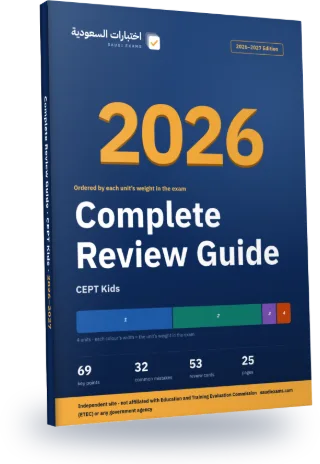
- Complete Review Guide 2026–2027 (PDF)Ordered by each unit's weight in the exam. With lifetime access only.
Choose your access
Continue with your Google account and you go straight to the payment page.