CEPT – English Proficiency Test for Children
A guide to the CEPT English test for children: its sections, sub-topics, question style, and how this site's practice bank maps to it.
- Questions and time
- 46 questions: 20 listening, 20 reading, 3 writing, 3 speaking · ETEC does not publish the test duration
- Pass mark
- No published pass mark; the test describes the child's English competencies
- Exam fee
- ETEC's test page does not state a fee
Start with 10 free questions to find what needs more work. No sign-up, with answer explanations.
Try 10 free questions and see your levelPut what you just read into practice
Start with 10 free questions to find what needs more work. No sign-up, with answer explanations.
Try 10 free questions and see your levelInformation last checked: 22 November 2026. This site is independent and is not affiliated with the Ministry of Education or ETEC. This guide explains the published syllabus of the CEPT English test for children and how our practice bank relates to it. Items that are not published are marked as such.
What the test is
The CEPT (English Proficiency Test for Children) measures children's English-language competencies across four skills: listening comprehension, reading comprehension, writing, and speaking. It is designed to measure these skills objectively and reliably. Its status is pilot (تجريبي).
Target age: children aged 9 to 12. ETEC names these beneficiaries: researchers interested in English; parents who want to know their child's English level at this age and whether the child is ready for a higher level; and curriculum evaluators, schools and teachers.
Goals
- Identify children's English competencies.
- Strengthen basic English skills.
Sections and number of questions
- Listening comprehension: 20 questions
- Reading comprehension: 20 questions
- Writing: 3 questions
- Speaking: 3 questions
Total: 46 questions.
Question style
In the real test, writing and speaking are open-response. The exact format of these tasks is not published. The question types used in listening and reading are not published either.
Not published
- Duration
- Fee
- CEFR level
- Score scale or report format
- Test dates
- Whether the test is on computer or paper
- Exact format of writing and speaking tasks
Registration
Registration is through the beneficiary profile on the ETEC e-services portal. Official test information is on the ETEC test page.
How the practice bank maps to the test
The bank is English only, like the test. Its items are practice items written for this site, not ETEC questions.
- Listening (maps to the listening section): short audio clips with synthetic voices of everyday conversations, announcements, instructions and short descriptions. Questions check details, gist and the speaker's purpose.
- Reading (maps to the reading section): short signs, notices, messages, instructions, stories and information texts. Questions check details, main idea, vocabulary in context and simple inference.
- Writing and speaking: because the real tasks are open-response, practice uses multiple-choice items: choosing the correct word or sentence for a message, ordering ideas, choosing a suitable reply or question, and polite expressions.
Topic scope
Topics follow the Council of Europe descriptors for young learners aged 7 to 10, at Pre-A1 to A2 everyday topics: family, school, food, animals, hobbies, weather, shopping, times and numbers.
Tips for parents
- Do short listening practice daily.
- Read aloud together.
- Keep a simple English diary.
- Describe pictures aloud.
The child practises; the parent sees which skills need work.
Finished reading? Try a set of questions
Start with 10 free questions to find your weakest units. Keep practising with the full question bank and mock exams from SAR 26.
Put the plan to work here
SAR 34 $9
One purchase · lifetime access · review guide included
- 574 questions, every option explained with its source
- Timed supplementary practice sessions: 46 questions in 90 minutes
- Practice that starts with your weakest units, plus a review of your mistakes
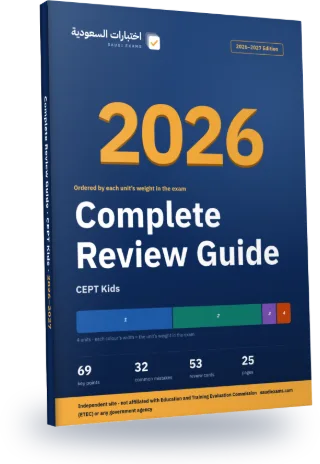 Complete Review Guide 2026–2027 included (PDF)Ordered by the weight of each unit in the examBuy now · SAR 34or 7 days for SAR 26
See everything included
Timed supplementary practice and 574 explained questions to review your weak areas
- Repeat supplementary practice sessions and review performance by unit
- Practise 10 weak-area questions, starting where you lose the most marks
- 574 questions explaining why every option is right or wrong
- Arabic and English with one pass
- Unit notes and flashcards, then questions to check your understanding
A pilot test for children aged 9–12; it helps parents learn their child's English level and readiness for a higher level. Source Last verified: 2026-11-22
Sources and references
- ETEC – اللغة الإنجليزية للأطفال CEPT (تجريبي) etec.gov.sa
- ETEC e-services portal e-services.etec.gov.sa