What Qudrati 1 Measures: Two Sections and Nine Domains
Qudrati 1 for Grade 3 and 4 students: a verbal section and a quantitative section, nine domains with a short example for each, and how it differs from the university aptitude test and Mawhiba.
- Questions and time
- The number of questions for this level is not published; press reports of ETEC's launch give 40 to 60 questions depending on the level · The time for Level 1 is not published; press reports of ETEC's launch say about 60 minutes on average
- Pass mark
- Qudrati has no pass or fail; the report gives a total score and a score for each domain
- Exam fee
- Not stated on the official page
Start with 10 free questions to find what needs more work. No sign-up, with answer explanations.
Try 10 free questions and see your levelPut what you just read into practice
Start with 10 free questions to find what needs more work. No sign-up, with answer explanations.
Try 10 free questions and see your levelInformation last checked: 22 November 2026. Sources: the Qudrati tests page on the ETEC website, and an Al-Yaum newspaper report on the launch of the test, a secondary press source for the question count and time. This is an independent guide, not affiliated with the Education and Training Evaluation Commission (ETEC).
What does Qudrati 1 measure?
Qudrati 1 is for Grade 3 and Grade 4 primary students. It is Level 1 of four levels. It measures general ability in understanding, analysis, reasoning and application. ETEC says it gives parents early indicators of their child's level and helps follow the child's progress.
The two sections
The test has two sections:
- Verbal section: five domains. At Level 1 it includes visual analogy and visual comprehension.
- Quantitative section: four domains.
The nine domains and an example for each
Each example describes the type of question only. It is not a full question.
- Verbal analogy: a pair of words has a relation, such as part and whole, tool and purpose, animal and home, or opposite and synonym. The child finds the option with the same relation.
- Visual analogy: two shapes differ by one change, such as colour, size, number of dots or rotation. The child applies the same change to a third shape.
- Odd one out: four words or pictures, three of which belong to one group or share one feature. The child finds the one that does not fit.
- Sentence completion: a sentence with a gap. The child chooses the word that completes the meaning, or the right linking word.
- Contextual error: a sentence with one word that does not fit the meaning, and the child finds it. In the second type, the whole sentence does not fit the topic of the passage.
- Reading and visual comprehension: a short passage followed by questions on the main idea, details and inference. There is also a question on a simple table or picture.
- Numbers and quantities: place value, addition, subtraction, multiplication and division, simple fractions, money and time.
- Patterns and relationships: a row of numbers or shapes that follows a rule. The child completes the missing part.
- Shapes and measurement: simple shapes and their properties, perimeter and area by counting squares, and units such as centimetres, kilograms and litres.
- Data and statistics: reading a simple table, pictographs, bar charts, and counting and ordering.
These examples describe how we practise each domain. They are not questions from ETEC. ETEC names the domains but does not publish example questions.
How many questions from each section?
ETEC has not published the number of questions for this level, or the number for each domain. Al-Yaum reported ETEC's statement at the launch that the number is 40 to 60 questions depending on the level. So we built our practice on about 50 questions. This is an assumption of this site, not a split from ETEC:
- Verbal section: 25 questions, five for each domain.
- Quantitative section: 25 questions, with 7 for numbers and quantities, 6 for patterns, 6 for shapes and measurement, and 6 for data and statistics.
How is it different from the university aptitude test and from Mawhiba?
- General aptitude test for university admission: for high school students, used for university admission. Qudrati copies its format, and is given early to prepare the student.
- Qudrati: measures a child's general ability level. It gives a diagnostic report with a total score and a score for each domain. There is no pass or fail, and it does not select students for any programme.
- Mawhiba: a selection test for gifted students. It has a fee and a scale from 1000 to 2000. It is not a general ability check for all students, as Qudrati is.
Qudrati is not an entry to a gifted programme, and it does not decide a child's school future.
Finished reading? Try a set of questions
Start with 10 free questions to find your weakest units. Keep practising with the full question bank and mock exams from SAR 26.
Put the plan to work here
SAR 34 $9
One purchase · lifetime access · review guide included
- 549 questions, every option explained with its source
- Timed supplementary practice sessions: 50 questions in 90 minutes
- Practice that starts with your weakest units, plus a review of your mistakes
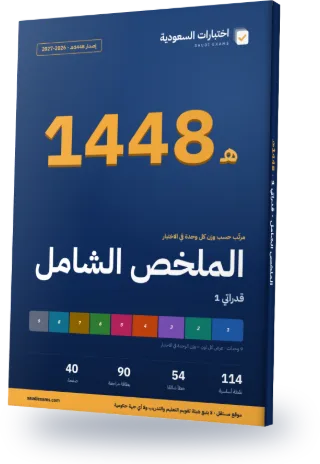 Complete Review Guide 2026–2027 included (PDF)Ordered by the weight of each unit in the examBuy now · SAR 34or 7 days for SAR 26
See everything included
Timed supplementary practice and 549 explained questions to review your weak areas
- Repeat supplementary practice sessions and review performance by unit
- Practise 10 weak-area questions, starting where you lose the most marks
- 549 questions explaining why every option is right or wrong
- Arabic and English with one pass
- Unit notes and flashcards, then questions to check your understanding
Qudrati measures a student's general ability level and gives a detailed report. There is no pass or fail, and it is not a gifted selection test. Its purposes are diagnosis, follow-up, and early preparation for the university-admission aptitude test. Source Last verified: 2026-11-22