A 4-Week Practice Plan for Qudrati 1
A plan for parents of children aged 8 to 10: short sessions every day, one or two domains each week, how to use the free questions, and the score for each domain.
- Questions and time
- The number of questions for this level is not published; press reports of ETEC's launch give 40 to 60 questions depending on the level · The time for Level 1 is not published; press reports of ETEC's launch say about 60 minutes on average
- Pass mark
- Qudrati has no pass or fail; the report gives a total score and a score for each domain
- Exam fee
- Not stated on the official page
Start with 10 free questions to find what needs more work. No sign-up, with answer explanations.
Try 10 free questions and see your levelPut what you just read into practice
Start with 10 free questions to find what needs more work. No sign-up, with answer explanations.
Try 10 free questions and see your levelInformation last checked: 22 November 2026. Sources: the Qudrati tests page on the ETEC website, and an Al-Yaum newspaper report for the test length and question count. This is an independent guide, not affiliated with the Education and Training Evaluation Commission (ETEC).
This plan is an order for practice. It does not guarantee any score. Its aim is for your child to get used to each type of question, and for you to see where the child needs help.
Before you start
- Start with the ten free questions on the site. You do not need to sign up.
- After answering, you will see the score for each domain. Write down the two weakest domains for your child, and start with them.
- Sit with your child for the first few minutes and read the instructions together. Then let the child answer alone.
- The score on this site is an estimate. It is not ETEC's score.
Every day: about 15 minutes
- Five days a week, with one rest day. Keep each session to 15 minutes or less. Children of this age tire quickly.
- In each session, do 5 to 8 questions from the domain of the week, then review the mistakes together.
- When you review, do not give the answer straight away. Ask: what is the link between the first two words? Or: what changed from the first shape to the second?
- If your child gets tired or bored, stop. A short session that goes well is better than a long one the child dislikes.
Week 1: analogy and odd one out
- Verbal and visual analogy: find the relation before you look at the options.
- Odd one out: ask your child to say why the option that does not fit does not belong with the group.
- At the end of the week, check the score for these two domains. Compare it with the week before if you have taken the test before.
Week 2: sentence completion and contextual error
- Sentence completion: read the sentence aloud, and name the meaning the gap needs before choosing.
- Contextual error: ask your child to explain what does not fit the meaning of the sentence.
- Remind your child of common linking words, such as because and but, and ask them to use one in a sentence of their own.
Week 3: reading and visual comprehension, numbers and quantities
- Reading comprehension: after each passage, ask your child for the main idea, then for one detail in the text.
- Numbers and quantities: use numbers in daily life, such as money at the shop and the time before school. Practise mental and written arithmetic. The ETEC page does not mention a calculator for this test, so do not rely on one during practice.
- In the last session of the week, do 10 questions from these two domains under time, then check the score for each domain.
Week 4: patterns, shapes and data, then a full practice test
- Patterns and relationships: ask your child to describe the rule in their own words before completing the missing part.
- Shapes and measurement: collect objects at home and measure their length in centimetres.
- Data and statistics: read a simple table or a pictograph together, and ask your child to name the largest and smallest value.
- Do one full practice test in two or three sittings, not in one day. Afterwards, check the score for each domain, and choose the two weakest domains for review in the last days before the real test.
After the four weeks
If a domain score improves, keep one short session a week on that domain. If it does not, ask your child's school which part needs help, and do not make practice a pressure on your child.
Finished reading? Try a set of questions
Start with 10 free questions to find your weakest units. Keep practising with the full question bank and mock exams from SAR 26.
Put the plan to work here
SAR 34 $9
One purchase · lifetime access · review guide included
- 549 questions, every option explained with its source
- Timed supplementary practice sessions: 50 questions in 90 minutes
- Practice that starts with your weakest units, plus a review of your mistakes
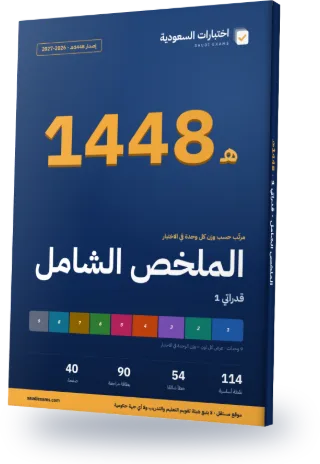 Complete Review Guide 2026–2027 included (PDF)Ordered by the weight of each unit in the examBuy now · SAR 34or 7 days for SAR 26
See everything included
Timed supplementary practice and 549 explained questions to review your weak areas
- Repeat supplementary practice sessions and review performance by unit
- Practise 10 weak-area questions, starting where you lose the most marks
- 549 questions explaining why every option is right or wrong
- Arabic and English with one pass
- Unit notes and flashcards, then questions to check your understanding
Qudrati measures a student's general ability level and gives a detailed report. There is no pass or fail, and it is not a gifted selection test. Its purposes are diagnosis, follow-up, and early preparation for the university-admission aptitude test. Source Last verified: 2026-11-22