What Qudrati 2 Measures: Two Sections and Nine Domains
Qudrati 2 for Grade 5 and Grade 6 primary students: a verbal section and a quantitative section, nine domains with a short example for each, and how it differs from the university aptitude test and Mawhiba.
- Questions and time
- The number of questions for this level is not published; press reports of ETEC's launch give 40 to 60 questions depending on the level · The time for Level 2 is not published; press reports of ETEC's launch say about 60 minutes on average
- Pass mark
- Qudrati has no pass or fail; the report gives a total score and a score for each domain
- Exam fee
- Not stated on the official page
Start with 10 free questions to find what needs more work. No sign-up, with answer explanations.
Try 10 free questions and see your levelPut what you just read into practice
Start with 10 free questions to find what needs more work. No sign-up, with answer explanations.
Try 10 free questions and see your levelInformation last checked: 22 November 2026. Sources: the Qudrati tests page on the ETEC website, and an Al-Yaum newspaper report on the launch of the test, a secondary press source for the question count and time. This is an independent guide, not affiliated with the Education and Training Evaluation Commission (ETEC).
What does Qudrati 2 measure?
Qudrati 2 is for Grade 5 and Grade 6 primary students. It is Level 2 of four levels. It measures general ability in understanding, analysis, reasoning and application. ETEC says it gives parents indicators of their child's level and helps follow progress from one level to the next.
The two sections
The test has two sections:
- Verbal section: five domains, all based on reading words, sentences and texts.
- Quantitative section: four domains in numbers, algebra, geometry and data.
The nine domains and an example for each
Each example describes the type of question only. It is not a full question.
- Verbal analogy: a pair of words has a relation, such as part and whole, tool and job, cause and effect, opposite, or degree. The student chooses a pair with the same relation.
- Odd one out: four words, three of which share one category, quality or relation. The student finds the word that does not belong.
- Sentence completion: a sentence with one or two gaps. The student chooses the word or linking word that completes the meaning.
- Contextual error: a sentence with one word that does not fit the meaning. A second type: a paragraph with one sentence that is off topic.
- Reading comprehension: a passage of about 80 to 140 words, followed by questions on the main idea, details, inference, and the meaning of a word in context.
- Numbers and quantities: fractions and decimals, simple percent, multiples and factors, and everyday problems with two or three steps.
- Patterns and relationships: number, letter and time patterns that follow a rule, and simple equations with one unknown number.
- Shapes and measurement: angles and triangles, perimeter and area, the volume of a box, and converting units.
- Data and statistics: reading tables and bar charts, and finding the mean.
These examples describe each domain in our practice. They are not ETEC questions. ETEC names the domains but does not publish examples.
How many questions in each section?
ETEC has not published the number of questions for this level, or for each domain. At the launch, Al-Yaum reported from ETEC that the test has 40 to 60 questions depending on the level. So we built our practice on about 50 questions. This is our site's assumption, not an ETEC split:
- Verbal section: 25 questions, five for each domain.
- Quantitative section: 25 questions: 7 for numbers and quantities, 6 for patterns and relationships, 6 for shapes and measurement, and 6 for data and statistics.
How is it different from the aptitude test and Mawhiba?
- General Aptitude Test for university admission: for secondary school students, and used for university admission. Qudrati looks similar in question style and is given at earlier stages.
- Qudrati: measures the student's level in general abilities, and gives a report with a total score and a score for each domain. There is no pass or fail, and it does not select students for any programme.
- Mawhiba: a scale for selecting students for gifted programmes, with its own fee and scoring system. It does not measure general abilities for everyone as Qudrati does.
Qudrati is not registration for a gifted programme, and it does not decide a student's school future.
Finished reading? Try a set of questions
Start with 10 free questions to find your weakest units. Keep practising with the full question bank and mock exams from SAR 26.
Put the plan to work here
SAR 34 $9
One purchase · lifetime access · review guide included
- 606 questions, every option explained with its source
- Timed supplementary practice sessions: 50 questions in 90 minutes
- Practice that starts with your weakest units, plus a review of your mistakes
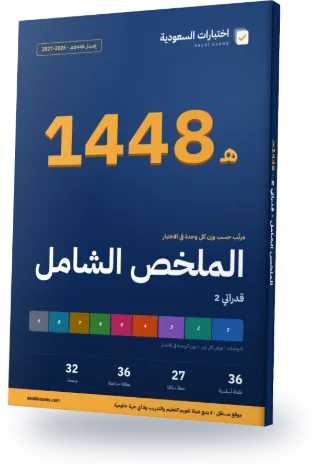 Complete Review Guide 2026–2027 included (PDF)Ordered by the weight of each unit in the examBuy now · SAR 34or 7 days for SAR 26
See everything included
Timed supplementary practice and 606 explained questions to review your weak areas
- Repeat supplementary practice sessions and review performance by unit
- Practise 10 weak-area questions, starting where you lose the most marks
- 606 questions explaining why every option is right or wrong
- Arabic and English with one pass
- Unit notes and flashcards, then questions to check your understanding
Qudrati measures a student's general ability level and gives a detailed report. There is no pass or fail, and it is not a gifted selection test. Its purposes are diagnosis, follow-up, and early preparation for the university-admission aptitude test. Source Last verified: 2026-11-22