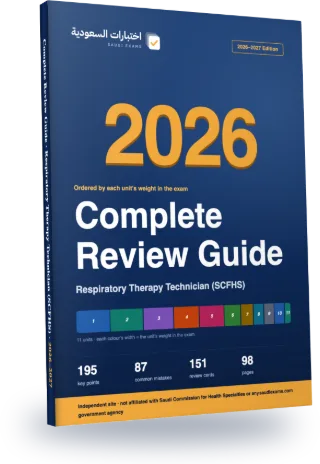
الملخص الشامل لفني العلاج التنفسي (الهيئة) 1448
كل نقاط الاختبار في ملف PDF من 98 صفحة، مرتبة من الوحدة الأكبر وزنًا إلى الأصغر. الفصول الثلاثة الأولى وحدها نحو 44% من أسئلة الاختبار.
- 98الصفحات
- 195النقاط الأساسية
- 87الأخطاء الشائعة
- 151بطاقات المراجعة
خريطة الملخص
كل فصل وحدة من وحدات الاختبار. الترتيب حسب وزن الوحدة في الاختبار الحقيقي.
| الفصل | الوحدة | الوزن | أسئلة الاختبار | نقاط الملخص |
|---|---|---|---|---|
| 1 | التقييم والتقويم | 15% | 23 | 18 |
| 2 | تشغيل الأجهزة واستكشاف الأعطال ومراقبة الجودة | 15% | 22 | 18 |
| 3 | الإجراءات العلاجية | 14% | 21 | 18 |
| 4 | سلامة مجرى الهواء والعناية به | 12% | 18 | 18 |
| 5 | التنفس الاصطناعي | 12% | 18 | 18 |
| 6 | بيانات المريض | 8% | 12 | 18 |
| 7 | تقنيات النظافة القصبية | 6% | 9 | 18 |
| 8 | مكافحة العدوى | 5% | 8 | 16 |
| 9 | التأهيل الرئوي والرعاية المنزلية | 5% | 7 | 18 |
| 10 | سلامة المريض | 5% | 8 | 18 |
| 11 | تثقيف المريض | 3% | 4 | 17 |
الفصل الأول كاملًا: التقييم والتقويم
15% من الاختبار، نحو 23 سؤالًا. هذه نقاطه الأساسية كما في الملخص.
- (Physical assessment) Quiet inspiration is active: the diaphragm and external intercostals contract. Quiet expiration is passive elastic recoil. Intrapleural pressure stays near -4 mm Hg, below intra-alveolar pressure. The main factor stimulating the medulla and pons to produce breathing is blood CO2 concentration, not oxygen. Source: OpenStax Anatomy and Physiology 2e, Section 22.3.
- (Physical assessment) Respiratory rate is the single best predictor of severe illness, and tachypnea and tachycardia are more common than visible cyanosis in hypoxemia. Cyanosis is hard to judge, especially in poor light or with anemia, so check SpO2. Check SpO2 and consider a blood gas in unexplained confusion or agitation. Source: BTS Emergency Oxygen Guideline 2017, sections 7.1.1 and B1.
- (Auscultation) In asthma the most frequent sign is expiratory wheeze; it can be absent in a severe exacerbation (silent chest) when other signs of respiratory failure are present. Crackles and inspiratory wheezing are not features of asthma. Detailed sound subtypes agree poorly between clinicians, but the broad categories crackles and wheezes are more reliable. Pooled sensitivity of auscultation is 37% and specificity 89%, and abnormal breath sounds are highly specific for pneumothorax in trauma. Sources: GINA 2024; ERS lung sounds study (2016); auscultation meta-analysis (2020).
بقية الفصل الأول على هذه الصفحة
- (Arterial blood gases) Arterial puncture: a negative modified Allen test means pick another extremity. Do not puncture through a lesion or through or distal to a surgical shunt. Coagulopathy or medium-to-high-dose anticoagulation is a relative contraindication. Femoral punctures should not be done outside the hospital. Rotate sites for repeated sampling and consider an indwelling catheter when many samples are expected. Source: AARC CPG Sampling for ABG Analysis 1992, ABS 5.0 and 12.0.
- (Arterial blood gases) Handling: expel any air bubble at once, before mixing or chilling. Liquid heparin dilutes the sample and lowers PCO2 and electrolytes while pH and PO2 are relatively unaffected, so expel excess heparin. A plastic-syringe sample kept at room temperature is analyzed within 30 min (within 5 min for a shunt study); for longer delay use a glass syringe chilled to 0 to 4 degrees C. A very high white cell count needs immediate cooling and analysis. From an arterial line, clear the flush solution first. Report values measured at 37 degrees C; temperature correction is not recommended, and any corrected value must be labelled. Sources: AARC CPG Blood Gas Analysis and Hemoximetry 2013, BGA 4.5 and 6.1; AARC 1992; Sood 2010.
- (ABG interpretation) Step 1: pH below 7.40 is acidosis, above 7.40 alkalosis (normal 7.35 to 7.45). Step 2: if PaCO2 explains the pH change the primary disorder is respiratory, otherwise check HCO3 for a metabolic disorder. Compensation: acute respiratory acidosis HCO3 rises 1 mEq/L per 10 mm Hg PaCO2 above 40, chronic 3.5; acute respiratory alkalosis HCO3 falls 2 per 10 below 40, chronic 5. Metabolic acidosis: expected PaCO2 = 1.5 x HCO3 + 8 (plus or minus 2); PaCO2 below that means added respiratory alkalosis, above means added respiratory acidosis. Metabolic alkalosis: expected PaCO2 = 0.7 x HCO3 + 21 (plus or minus 2). Source: Sood 2010, Indian J Crit Care Med.
- (ABG interpretation) Anion gap = Na - (Cl + HCO3); the normal is 8 plus or minus 4 with potassium omitted, 12 plus or minus 4 with it. A high gap suggests added acid anions (lactate, ketoacids, renal failure, salicylate); an inorganic acidosis such as HCl infusion has a normal gap. Low albumin lowers the gap. A normal-gap acidosis is hyperchloremic. In pure high-gap acidosis the rise in anion gap equals the fall in HCO3 (ratio 1); a ratio below 1 suggests an added normal-gap acidosis. Source: Sood 2010.
- (ABG oxygenation) PAO2 = FiO2 x (PB - 47) - PaCO2 / 0.8. An alveolar-arterial gradient below 20 mm Hg with hypoxemia points to an extrapulmonary cause such as hypoventilation (for example Guillain-Barre syndrome or drug overdose). Never judge PaO2 without the FiO2. PaO2/FiO2 grades ARDS: mild 201 to 300, moderate 101 to 200, severe below 100. Type 1 respiratory failure is PaO2 below 60 mm Hg with normal or low PaCO2. Capillary or venous samples can show pH and PCO2 in stable patients but underestimate oxygenation. Hemoximetry (CO-oximetry) measures carboxyhemoglobin and methemoglobin; fetal hemoglobin makes a calculated saturation read too low. Sources: Sood 2010; AARC 2013, 6.1.7 and 6.1.8; BTS 2017, 3.2; ARDS guideline.
- (Pulse oximetry) SpO2 estimates arterial saturation. Reliability falls with motion, carboxyhemoglobin and methemoglobin, intravascular dyes, ambient light, low perfusion, skin pigmentation and nail polish. It is less accurate below 83% and cannot quantify hyperoxemia; hyperbilirubinemia does not affect it. Check the plethysmograph waveform and that pulse rate matches palpation. If SpO2 and the clinical picture disagree and alternate probes or sites fail, request an ABG. In carbon monoxide poisoning a normal-looking reading can mislead, so give a reservoir mask at 15 L/min. Sources: AARC CPG Pulse Oximetry 1992, 7.1 to 7.5; BTS 2017, E6.
- (Capnography) All intubations must be confirmed by some form of PETCO2 measurement, with waveform capnography preferred in addition to clinical assessment; a colorimetric or non-waveform detector is the alternative in cardiac arrest. During transport confirm a consistent waveform at the scene, in the vehicle, on arrival and after any transfer. Capnography detects a change in ventilation sooner than pulse oximetry. Leaks, a filter on the sampling line and a very high rate can make it inaccurate. Source: AARC CPG Capnography/Capnometry During Mechanical Ventilation 2011, 4.1, 4.2 and 7.
- (Capnography in CPR and dead space) A PETCO2 of about 10 mm Hg during CPR means improve compression quality; an abrupt sustained rise signals return of spontaneous circulation. A transient rise after sodium bicarbonate does not. The PaCO2-PETCO2 difference widens with dead space and varies over time, so capnography cannot replace PaCO2. Source: AARC 2011, 4.1.5, 4.3.4 and 7.7.3.
- (Spirometry) Relative contraindications include hemoptysis of unknown origin and an untreated pneumothorax. Per ATS/ERS 2019: verify volume daily with a 3-L syringe (error within 3%). Acceptable maneuvers have back-extrapolated volume below 5% of FVC or 0.100 L (whichever is greater), no cough or glottic closure in the first second, and an end-of-forced-expiration sign: plateau (change under 0.025 L for at least 1 s), expiratory time of 15 s, or an FVC that repeats within tolerance when no plateau is possible. Repeatability: the two largest FVC and FEV1 values within 0.150 L (adults); usually at least 3 and at most 8 maneuvers. Sources: ATS/ERS Spirometry Standards 2019, Tables 6 and 7; AARC CPG Spirometry 1996, 5.0.
- (Spirometry interpretation) Per ERS/ATS 2022: use the lower limit of normal (5th percentile, z-score -1.645) rather than a fixed FEV1/FVC of 0.7 or 80% predicted. Obstruction is a low FEV1/FVC; a low FVC with a normal ratio is possible restriction until a low TLC confirms it. Obstruction with a low FVC needs lung volumes to look for mixed disorder. Severity by z-score: mild -1.65 to -2.5, moderate -2.51 to -4.0, severe below -4.1. A significant bronchodilator response is a change above 10% of predicted FEV1 or FVC. An FEV1 (mL) to PEF (L/min) ratio above 8 suggests central or upper airway obstruction. A concave expiratory flow-volume limb suggests small airway dysfunction. Source: ERS/ATS Interpretive Strategies 2022.
- (Lung volumes) TLC = RV + VC, or FRC + IC. Gas dilution FRC can be underestimated in airflow limitation and air trapping; body plethysmography can overestimate it in severe obstruction if panting exceeds about 1 cycle/s. Nitrogen washout uses 100% oxygen, so watch CO2 retainers for depressed ventilatory drive. Plethysmography is limited by claustrophobia and by patients who cannot fit in the box or stop IV therapy or oxygen. Sources: AARC CPG Static Lung Volumes 2001, 5.0 to 7.1; AARC CPG Body Plethysmography 2001.
- (DLCO and challenge tests) Single-breath DLCO: absolute contraindications are carbon monoxide toxicity and dangerous oxyhemoglobin desaturation without oxygen; smoking within 24 h is relative. Breath-hold is 9 to 11 s and tests agree within 10% or 3 mL/min/mmHg. Adjust for hemoglobin (anemia lowers DLCO) and COHb: COHb-adjusted DLCO = measured DLCO x (1 + %COHb/100). Methacholine is positive at a 20% fall in FEV1; contraindications include FEV1 below 50% of predicted or below 1.0 L, heart attack or stroke within 3 months, aortic or cerebral aneurysm, and uncontrolled hypertension. Sources: AARC CPG DLCO 1999, 5.0 and 9.0; AARC CPG Methacholine Challenge 2001, 2.2 and 5.0.
- (Walking and exercise tests) 6-minute walk: course of at least 30 m, standard encouragement phrases only, do not stop the timer if the patient rests, and stop for SpO2 below 80%. Do two tests because of a learning effect (rest 30 min or more between them); the minimal important difference is 30 m. Keep oxygen, encouragement and track constant on repeat testing. Exercise desaturation: SaO2 below 88% or PaO2 of 55 or less, with a 4% SpO2 fall significant. Sources: ERS/ATS Technical Standard on field walking tests (key findings, test protocol); AARC CPG Exercise Testing 2001, 2.0 and 6.1.
- (Chest radiograph) Check quality first: rotation (medial clavicle ends equidistant from the spinous processes) and inspiration (10 posterior ribs visible). Rotation makes one side darker and can mimic pneumothorax; poor inspiration crowds vessels and mimics heart failure. Cardiothoracic ratio is up to 50% on a PA film; an AP film magnifies the heart about 20%. Silhouette sign: loss of the right heart border means right middle lobe, left heart border means lingula, a hemidiaphragm means that lower lobe. Tension pneumothorax shows contralateral mediastinal shift; a deep sulcus sign suggests pneumothorax on a supine film; a pleural effusion has a meniscus. Source: The Chest Radiograph (2012).
- (Chest radiograph tubes and lines) Endotracheal tube tip about 5 cm above the carina with the head neutral (at least 3 cm below the cords); a malpositioned tube is the most common complication and the right main bronchus is typical, causing collapse. Tracheostomy tip midway between stoma and carina at about T3. NG tube tip and side hole below the gastroesophageal junction. Central venous catheter tip at or just above the cavoatrial junction, about two vertebral bodies below the carina. Chest drain side holes must lie inside the thorax. Source: Cardiac devices on chest radiograph, part 1 (PMC); AARAD slides.
أخطاء شائعة في هذا الفصل
- A normal SpO2 does not mean a normal blood gas: oximetry can look normal with abnormal pH or PCO2, anemia, or carbon monoxide poisoning.
- Absent cyanosis does not exclude hypoxemia, and a silent chest in severe asthma signals very limited airflow, not improvement. Check respiratory rate, SpO2 and signs of respiratory failure.
- Liquid heparin dilutes the sample and lowers PCO2 while pH and PO2 change little; a small air bubble mainly distorts PO2; a delayed sample with a high white cell count loses PO2.
- In a simple respiratory disorder, pH and PaCO2 move in opposite directions. If pH and PaCO2 move in the same direction, the primary problem is metabolic. If HCO3 and PaCO2 move in opposite directions, think mixed disorder.
- Capnography is not a substitute for PaCO2. A transient rise in PETCO2 after sodium bicarbonate during CPR is not better compressions or return of circulation. A negative CO2 result in arrest can mean esophageal placement or very poor pulmonary blood flow.
- A fixed FEV1/FVC of 0.7 and 80% predicted are not the interpretation standard in the 2022 ERS/ATS statement (the lower limit of normal, 5th percentile, is), although GOLD still uses a post-bronchodilator ratio below 0.7 to confirm COPD. A low FVC with a normal ratio is only possible restriction until TLC is measured.
- Older guideline numbers conflict with newer ones: the 2019 ATS/ERS back-extrapolated volume limit is 5% of FVC or 0.100 L (not 0.150 L) and the repeatability limit is 0.150 L (not 0.200 L). Gas dilution can underestimate FRC in air trapping, and plethysmography can overestimate it if panting is faster than about 1 cycle per second.
- Rotation and a poor inspiratory effort can mimic disease on a chest radiograph (a darker side, or crowded vessels that look like heart failure). A tube tip in the right main bronchus is the classic misplaced endotracheal tube.
بقية الفصول في الملخص الكامل
شراء واحد · وصول دائم · معه الملخص الشامل
خطة مراجعة 7 أيام
وزّعنا الفصول على 6 أيام حسب وزنها حتى يتقارب حمل كل يوم، واليوم السابع لاختبار كامل.
اليوم 1 · 15% من الاختبار
الفصل 1: التقييم والتقويم
اليوم 2 · 15% من الاختبار
الفصل 2: تشغيل الأجهزة واستكشاف الأعطال ومراقبة الجودة
اليوم 3 · 19% من الاختبار
الفصل 3: الإجراءات العلاجية
الفصل 10: سلامة المريضاليوم 4 · 17% من الاختبار
الفصل 4: سلامة مجرى الهواء والعناية به
الفصل 8: مكافحة العدوىاليوم 5 · 17% من الاختبار
الفصل 5: التنفس الاصطناعي
الفصل 9: التأهيل الرئوي والرعاية المنزليةاليوم 6 · 17% من الاختبار
الفصل 6: بيانات المريض
الفصل 7: تقنيات النظافة القصبية
الفصل 11: تثقيف المريضاليوم 7
اختبار تجريبي كامل: 150 سؤالًا في 180 دقيقة، ثم مراجعة «أخطاء شائعة» في الوحدات التي خسرت فيها.
كم إجابة صحيحة تحتاج؟
- درجة النجاح 55%83 إجابة صحيحة من 150
قبل أن تقرأ: اعرف درجتك اليوم
10 أسئلة مجانية من أهم الوحدات، بدون تسجيل. تعرف بعدها من أي فصل تبدأ.
جرّب 10 أسئلة مجانية واعرف مستواكلمحة من كل فصل
أول ثلاث نقاط من كل فصل كما تظهر في الملخص.
الفصل 1: التقييم والتقويم
- (Physical assessment) Quiet inspiration is active
- (Physical assessment) Respiratory rate is the single best predictor of severe illness, and tachypnea…
- (Auscultation) In asthma the most frequent sign is expiratory wheeze; it can be absent…
الفصل 2: تشغيل الأجهزة واستكشاف الأعطال ومراقبة الجودة
- (Oxygen delivery devices) Reservoir (non-rebreathing) mask
- (Oxygen delivery devices) Venturi mask
- (Oxygen delivery devices) Nasal cannula
الفصل 3: الإجراءات العلاجية
- (Oxygen therapy) BTS 2017 recommends prescribing oxygen to a target of 94–98% for most…
- (Oxygen therapy) AARC lists documented hypoxemia as PaO2 below 60 torr or SaO2 below…
- (Oxygen therapy) FIO2 of 0.5 or higher is linked with absorption atelectasis, oxygen toxicity…
الفصل 4: سلامة مجرى الهواء والعناية به
- (Airway positioning) The sniffing position aligns the external auditory canal with the sternal notch…
- (Airway positioning) If cervical spine injury is possible, keep the neck still, use the…
- (Airway emergencies) Signs of partial upper airway obstruction: ineffective efforts, paradoxical respiration, stridor, accessory…
الفصل 5: التنفس الاصطناعي
- (Indications and modes) In a hospitalized COPD exacerbation with acute respiratory failure, noninvasive ventilation…
- (Indications and modes) Modes
- (Indications and modes) Predicted body weight
الفصل 6: بيانات المريض
- (Chart review) Pack-years = packs smoked per day x years smoked (1.5 packs x…
- (Chart review) In severe COPD, weight loss, muscle loss and anorexia can also signal…
- (Chart review) A history of allergic rhinitis or eczema, or a family history of…
الفصل 7: تقنيات النظافة القصبية
- (Postural drainage) Each drainage position places the target lung segment superior to the carina;…
- (Postural drainage) Typical positions
- (Postural drainage) All positions are contraindicated with ICP above 20 mm Hg, head and…
الفصل 8: مكافحة العدوى
- (Standard precautions) Standard Precautions rest on the principle that all blood, body fluids, secretions…
- (Standard precautions) Aerosol-generating procedures such as suctioning without an in-line catheter, bronchoscopy and intubation…
- (Transmission-based precautions) Contact Precautions
الفصل 9: التأهيل الرئوي والرعاية المنزلية
- (Pulmonary rehabilitation) AARC definition
- (Pulmonary rehabilitation) Indications
- (Pulmonary rehabilitation) Potential contraindications
الفصل 10: سلامة المريض
- (Oxygen and fire safety) Oxygen supports combustion, so there is a fire risk near…
- (Oxygen and fire safety) For home oxygen
- (Cylinders) Never lift a cylinder by the neck. Apart from portable cylinders, move cylinders…
الفصل 11: تثقيف المريض
- (Inhaler technique) Check inhaler technique at every opportunity, and ask the patient to show…
- (Inhaler technique) Teaching cycle
- (Inhaler technique) Mastery may need 2 to 3 repeats within one session; consider another…
الملخص كاملًا مع الوصول الدائم
الملخص كاملًا (98 صفحة) يأتي مع الوصول الدائم لهذا الاختبار، ومعه كل الأسئلة والاختبارات التجريبية الكاملة. الفصل الأول مجاني للجميع.
أسئلة عن الملخص
هل الملخص مجاني؟
الفصل الأول مجاني للقراءة على صفحة الملخص. الملخص كاملًا يأتي مع الوصول الدائم لهذا الاختبار، ولا يشمله وصول 7 أيام.
هل يناسب اختبارات 1448؟
نعم. أوزان الوحدات ومعلومات الاختبار مكتوبة وفق آخر ما نشرته الجهة المنظمة، وتاريخ آخر تحقق مكتوب في الملخص. إذا تغيّرت المعايير نحدّث الملف، ومن اشترى يحمّل النسخة الجديدة.
هل في الملخص أسئلة؟
لا. الملخص للنقاط والأخطاء الشائعة فقط؛ قياس الدرجة والتدريب حسب نقاط الضعف والاختبارات التجريبية الكاملة على الموقع.
هل يُقرأ على الجوال؟
نعم. الصفحات بحجم A5 وعمود واحد، والفصول مرتبطة بالفهرس.
- عدد الصفحات
- 98
- الإصدار
- 1448هـ · 2026–2027
- اللغة
- العربية
- آخر تحديث
التحضير الكامل للاختبار
كل هذا في شراء واحد.
- اختبار تجريبي كامل مثل الحقيقي150 سؤالًا في 180 دقيقة. تخرج بدرجتك الكلية ودرجة كل وحدة.
- تدريب على كل وحدة577 سؤال، لكل خيار شرحه ومصدره. تبدأ بأضعف وحداتك.
- الملخص الشامل 1448 (PDF)مرتب حسب وزن كل وحدة في الاختبار. مع الوصول الدائم فقط.
اختر مدة الوصول
سجّل الدخول بحساب Google ثم تنتقل مباشرة إلى صفحة الدفع.