خطة مذاكرة اختبار أخصائي مختبرات الأحياء الدقيقة: 6 أسابيع وأسبوعان
خطة مراجعة لاختبار أخصائي المختبرات (الأحياء الدقيقة) بحسب أوزان الأقسام الخمسة: معظم الوقت للأحياء الدقيقة، واختبار تجريبي كامل قبل الموعد بيومين.
- الأسئلة والوقت
- 150 سؤالًا · 3 ساعات
- درجة النجاح
- 60%
- إجابة صحيحة للنجاح (60%)
- 90 من 150
- رسوم الاختبار
- تُسدَّد للهيئة إلكترونيًا عند التقديم عبر ممارس بلس، ويظهر المبلغ في طلبك
ابدأ بـ10 أسئلة مجانية واكتشف ما يحتاج إلى مراجعة. بدون تسجيل، ومع شرح الإجابات.
جرّب 10 أسئلة مجانية واعرف مستواكتدرّب على ما قرأته الآن
ابدأ بـ10 أسئلة مجانية واكتشف ما يحتاج إلى مراجعة. بدون تسجيل، ومع شرح الإجابات.
جرّب 10 أسئلة مجانية واعرف مستواكLast verified: 17 November 2026. Check the SCFHS classification exams page and the Laboratory – Microbiology content guideline (PDF) before you start, because weights and rules can change. This is an independent guide with no link to SCFHS, Prometric or any government body.
The exam has 150 questions across five sections, and Microbiology carries 60–70% of them. This plan gives Microbiology the first four weeks, puts the four small sections together in week five, and uses week six to close gaps and sit a full mock. The detail of each section is in the exam content guide, and the application steps are in the registration guide.
Numbers to build your plan on
| Item | What it means for your study |
|---|---|
| 150 multiple-choice questions | Per the SCFHS content guideline. The guideline does not state the number of options; our questions use four. |
| 3 hours | 180 minutes for 150 questions is 72 seconds a question. Practise sitting the full time in one go. |
| Pass mark 60% | That is 90 of 150 questions. Your result on this site shows your percentage in each section, so you can compare sections and track progress. |
| Weights can move by up to 5% per section | Do not skip a small section. Even the smallest is worth about 12 questions in our mock exam. |
| Language | The guideline does not state it. We treat the exam as English (our inference), so revise terms in English from the start. Our questions and explanations are in English. |
| Calculator | Not mentioned in the guideline, so practise calculations by hand with simple numbers. |
Split your time by section
The percentages are the official ranges. The question counts are the split in our 150-question full mock exam:
| Section | Official weight | Questions | Your time in the plan |
|---|---|---|---|
| Microbiology | 60–70% | 100 | Weeks 1–4 |
| Urinalysis and Other Body Fluids | 5–10% | 12 | Week 4 (1 day) and week 5 (1 day) |
| Immunology and Serology | 5–10% | 12 | Week 5 (1 day) |
| Laboratory Operations | 5–10% | 13 | Week 5 (1 day) |
| Patient Safety and Professionalism | 5–10% | 13 | Week 5 (1 day) |
Microbiology is two thirds of the paper, so it takes about two thirds of the weeks. The four small sections together are 50 questions, and week five gives each of them a focused day. They are short topics learned by pattern, so they reward revision more than long reading.
The 6-week plan
The plan assumes one to two hours a day. Count back six weeks from your booking date once SCFHS opens booking in your application. Each week has the same rhythm: five days of reading and practice, one day to redo the week's mistakes, and one light day.
Week 1: Baseline, specimens, culture and Gram-positive cocci
- Day 1: take the free practice test (10 free questions, no sign-up). Note your percentage in each section and your three weakest.
- Day 2: specimen collection and transport, Gram, acid-fast, fluorescent and wet-mount stains.
- Day 3: culture media, incubation conditions, biochemical tests, MALDI-TOF and molecular identification.
- Days 4–5: Staphylococcus, Streptococcus and Enterococcus. Build one-line cards with Gram appearance, medium, key tests and disease.
Week 2: Gram-positive bacilli, anaerobes and Enterobacterales
- Day 1: Gram-positive bacilli (Bacillus, Listeria, Corynebacterium and relatives).
- Day 2: Clostridium and other anaerobes.
- Days 3–4: Enterobacterales, with the biochemical tests that separate the genera.
- Day 5: Vibrio, Campylobacter and Helicobacter.
Week 3: Fastidious Gram-negatives, mycobacteria and susceptibility testing
- Day 1: non-fermenters (Pseudomonas, Acinetobacter and relatives).
- Day 2: Neisseria, Haemophilus and other fastidious Gram-negatives.
- Day 3: mycobacteria, spirochetes and cell-wall-deficient or intracellular bacteria.
- Days 4–5: antimicrobial susceptibility testing and resistance mechanisms. Read zone and MIC results and learn what each mechanism changes.
Week 4: Mycology, parasitology, virology and urine
- Day 1: medical mycology. Day 2: medical parasitology, focusing on life cycles and the diagnostic stage.
- Day 3: medical virology.
- Day 4: urine collection, physical and chemical examination, then urine microscopy and renal disease.
- Day 5: open the practice area, pick your two weakest Microbiology topics and do 10 questions from each.
Week 5: The four small sections
- Day 1: CSF, serous and synovial fluid and semen analysis, then a short urinalysis review.
- Day 2: Immunology and Serology: immunoglobulins, complement, hypersensitivity, immunoassay methods, infectious disease and autoimmune serology.
- Day 3: Laboratory Operations: quality control and basic statistics, laboratory mathematics, reagents and solutions. Do the calculations on paper.
- Day 4: Laboratory Operations (continued): biosafety, waste management, specimen management, instruments and quality management systems.
- Day 5: Patient Safety and Professionalism: patient identification, infection prevention, ethics, regulations, critical results.
Week 6: Close the gaps and sit the full mock
- Days 1–3: redo every question in your error notebook, then practise your weakest topics 10 questions at a time.
- Day 4: a light day. Skim your organism cards.
- Day 5 (two days before the exam): sit one full mock exam (next section).
- Day 6: review only the mistakes from the mock. Do not open a new topic.
The full mock exam, two days before the real one
- 150 questions in 180 minutes, in one sitting. The content guideline does not mention a break, so do not plan one.
- No phone and no notes. Calculate by hand.
- If a question stalls you, flag it and move on; at 72 seconds each, one slow question costs the next one.
- Afterwards, open the result for each section. The section with the lowest percentage is what you review on your last study day.
The 2-week plan if you are short of time
Build it on Microbiology, which is about two thirds of the exam, and keep a short pass over each small section:
| Day | Task |
|---|---|
| 1 | Free practice test (10 questions) and pick out your weakest sections |
| 2 | Specimens, stains, culture media and identification methods |
| 3 | Gram-positive cocci, then Gram-positive bacilli and anaerobes |
| 4 | Enterobacterales, Vibrio, Campylobacter and Helicobacter |
| 5 | Non-fermenters, Neisseria, Haemophilus and mycobacteria |
| 6 | Antimicrobial susceptibility testing and resistance mechanisms |
| 7 | Mycology, parasitology and virology |
| 8 | Urinalysis and other body fluids |
| 9 | Immunology and Serology |
| 10 | Laboratory Operations, with calculations on paper |
| 11 | Patient Safety and Professionalism |
| 12 | Error notebook and weakest topics (10 questions each) |
| 13 | Full mock exam: 150 questions in 180 minutes |
| 14 | Review only the mock's mistakes, then an early night |
How to handle your mistakes
- Read the explanation of every option, not just the correct answer. A wrong option today can be the right answer tomorrow.
- Write the cause of each mistake in one phrase: missing fact, mixed up two organisms or tests, calculation slip, or rushed reading. One cause usually repeats.
- Redo missed questions after two days, then after a week. When you answer one correctly twice in a row, take it out of your notebook.
What this site adds to your plan
- The free practice test: 10 free questions from the exam's sections, with the answer, its explanation and your percentage in each section, no sign-up.
- The practice area: practise section by section, with an error notebook and practice on your weakest topics. The remaining questions need a paid pass.
- The full mock exam of 150 questions in 180 minutes, the same question count and total time as the guideline. It also needs a paid pass.
This is an independent exam preparation website with no link to SCFHS, Prometric or any government body.
انتهيت من القراءة؟ جرّب مجموعة أسئلة
ابدأ بـ10 أسئلة مجانية لتعرف أضعف وحداتك. واصل التدريب ببنك الأسئلة والاختبارات التجريبية الكاملة من 26 ر.س.
نفّذ الخطة هنا
34 ر.س $9
شراء واحد · وصول دائم · معه الملخص الشامل
- 572 سؤالًا: لكل خيار شرحه ومصدره
- اختبارات كاملة: 150 سؤالًا في 180 دقيقة مثل الحقيقي
- تدريب يبدأ بأضعف وحداتك، ومراجعة لأخطائك
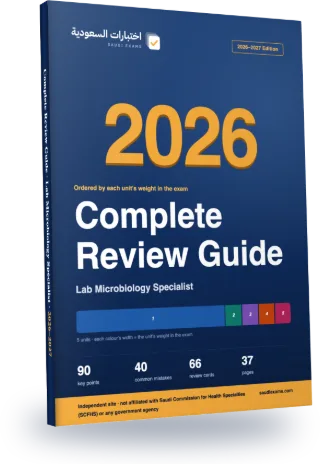 الملخص الشامل 1448 هدية (PDF)مرتب حسب وزن كل وحدة في الاختباراشترِ الآن · 34 ر.سأو 7 أيام بـ 26 ر.س
شاهد كل ما يشمله الوصول
اختبارات تجريبية كاملة مثل الحقيقي، و572 سؤالًا مشروحًا لتعرف نقاط ضعفك وتتدرّب عليها
- اختبارات تجريبية كاملة بلا حد لتدريب السرعة وقياس أدائك في الاختبار كاملًا
- تدرّب على 10 أسئلة من نقاط ضعفك وابدأ بما يخسرك أكثر
- 572 سؤالًا مع شرح سبب صحة أو خطأ كل خيار
- العربية والإنجليزية بوصول واحد
- ملخصات الوحدات وبطاقات المراجعة، ثم أسئلة تختبر فهمك
نتيجة هذا الاختبار جزء من التصنيف المهني لأخصائي المختبرات في تخصص الأحياء الدقيقة، ولا تصدر رخصة المزاولة دون التصنيف. وإذا لم تنجح تُمنح محاولات إضافية وفق أنظمة الهيئة وتدفع رسوم التقييم. المصدر آخر تحقق: 2026-11-17