محتوى اختبار أخصائي مختبرات أمراض الدم: الأقسام الخمسة وأوزانها
الأقسام الخمسة لاختبار أخصائي المختبرات (أمراض الدم) بنسبها في دليل المحتوى، وما يغطيه كل قسم، وتوزيع أسئلة اختبارنا التجريبي.
- الأسئلة والوقت
- 150 سؤالًا · 3 ساعات
- درجة النجاح
- 60%
- إجابة صحيحة للنجاح (60%)
- 90 من 150
- رسوم الاختبار
- تُسدَّد للهيئة إلكترونيًا عند التقديم عبر ممارس بلس، ويظهر المبلغ في طلبك
ابدأ بـ10 أسئلة مجانية واكتشف ما يحتاج إلى مراجعة. بدون تسجيل، ومع شرح الإجابات.
جرّب 10 أسئلة مجانية واعرف مستواكتدرّب على ما قرأته الآن
ابدأ بـ10 أسئلة مجانية واكتشف ما يحتاج إلى مراجعة. بدون تسجيل، ومع شرح الإجابات.
جرّب 10 أسئلة مجانية واعرف مستواكLast checked: 17 November 2026. Weights and content can change at any time, so check the classification exams page on the SCFHS website and the Laboratory – Hematology content guideline (PDF) before you start studying. This is an independent website, not affiliated with the Saudi Commission for Health Specialties (SCFHS) or Prometric.
The SCFHS Laboratory Specialist – Hematology exam has five sections. Hematology carries 60–70% and Blood Bank 15–20%, so together they are most of the paper. The other three (Immunology and Serology, Laboratory Operations, Patient Safety and Professionalism) carry 5–10% each. Use this page to decide where to start.
Exam format at a glance
| Item | Details |
|---|---|
| Questions | 150 multiple-choice questions |
| Time | 3 hours |
| Pass mark | 60% |
| Distribution | The real distribution can differ from the published weights by up to 5% (plus or minus) in each section |
| Exam language | Not stated by SCFHS. The guideline and all its international references are in English, so we treat the exam as English (our inference) |
The five sections and their weights
SCFHS publishes a range for each section. The last column is the split we use in our full mock exams (150 questions). It is our choice within each range, set so the total is 150, and it is not an official count.
| Section | Official weight | Questions in our mock exam |
|---|---|---|
| 1. Hematology | 60–70% | 96 |
| 2. Blood Bank | 15–20% | 27 |
| 3. Immunology and Serology | 5–10% | 9 |
| 4. Laboratory Operations | 5–10% | 9 |
| 5. Patient Safety and Professionalism | 5–10% | 9 |
| Total | 150 |
Because the real weights can move by 5%, a small section can still be worth about 8 to 15 questions. Our practice questions follow the same split, and your result is shown section by section.
A note on detail: the SCFHS guideline names the five sections and gives a weight range for each. It has no topic list. The topic lists below are our own breakdown, built from the chapters of the reference books SCFHS names, and are not an official outline.
Section 1: Hematology (60–70%, 96 questions)
This is the largest section. We split it into eleven topics.
- Hematopoiesis, CBC and analyzers: red cell indices, histograms and flags, and common counting interferences.
- Blood film examination: red cell morphology and inclusions.
- Anemias: iron deficiency, megaloblastic, anemia of chronic disease and aplastic anemia.
- Hemolytic anemias and hemoglobinopathies: G6PD deficiency, sickle cell disease, thalassemia and PNH.
- Benign leukocyte disorders and white cell morphology.
- Acute leukemias and myelodysplastic syndromes.
- Myeloproliferative neoplasms, CML, CLL, lymphoma and myeloma.
- Flow cytometry, cytogenetics, molecular testing and bone marrow examination.
- Primary hemostasis and platelet disorders.
- Coagulation testing, factor deficiencies and von Willebrand disease.
- Thrombosis, thrombophilia, DIC and anticoagulant monitoring.
How to prepare: start with the CBC and the red cell disorders, because their results feed every other topic. For each anemia, learn the pattern of MCV, reticulocytes and iron or hemolysis tests, then read it back from a set of results. Learn leukemias by their key marker and the test that confirms them. For hemostasis, draw the screening tests (PT, aPTT, thrombin time, fibrinogen) against what each one detects and how heparin, warfarin and the direct oral anticoagulants change them.
Section 2: Blood Bank (15–20%, 27 questions)
- ABO, Rh and other blood group systems.
- Pretransfusion testing: antibody screen and identification, crossmatch and the direct antiglobulin test.
- Blood components: preparation, storage and indications.
- Transfusion reactions and hemolytic disease of the fetus and newborn.
- Donor selection, collection, infectious disease screening and blood bank quality control.
How to prepare: practise ABO forward and reverse typing discrepancies until you can name the likely cause from the pattern. For the antibody work-up, learn why each step is done (screen, panel, exclusion, selected cells) and what a positive direct antiglobulin test points to. Memorise storage temperatures and shelf lives by component, and the investigation steps for a suspected transfusion reaction.
Section 3: Immunology and Serology (5–10%, 9 questions)
- Immunoglobulins, complement and hypersensitivity.
- Autoimmunity and immunodeficiency.
- Immunoassay methods, HLA and transplant immunology.
How to prepare: understand each method's principle (what binds to what, and what is read) before memorising names. For autoimmune testing, link each antibody to the disease it supports and the method used to detect it.
Section 4: Laboratory Operations (5–10%, 9 questions)
- Quality control, statistics and proficiency testing.
- Preanalytical variables, specimen handling and method validation.
- Quality systems, accreditation, critical values and laboratory information.
How to prepare: practise reading a control chart and naming the Westgard rule that was broken, and what a shift or a trend means. Learn the causes of rejected specimens (clotted, hemolyzed, wrong tube, underfilled citrate) and what the laboratory does about each.
Section 5: Patient Safety and Professionalism (5–10%, 9 questions)
- Patient identification, specimen labelling and transfusion safety.
- Biosafety, infection control and occupational exposure.
- Ethics, confidentiality, patient rights and Saudi health practice law.
How to prepare: most questions give a workplace situation and ask for the safest or most professional action. Read the three Saudi documents on the reference list (patient rights and responsibilities, the Implementing Regulations of the Health Professions Practice Law, and the national standards for laboratories and blood banks), and practise choosing the action that protects the patient first.
Official reference list
SCFHS lists these as a study aid only. It states that the list does not imply endorsement of these references, and that exam questions are not necessarily taken from them.
- Keohane, Smith and Walenga, Rodak's Hematology (5th ed.)
- Rodak and Carr, Clinical Hematology Atlas (5th ed.)
- Harmening, Modern Blood Banking and Transfusion Practices (6th ed., 2012)
- Fung, Eder, Spitalnik and Westhoff, Technical Manual (19th ed., AABB Press, 2017)
- Todd, Spickett and Fairclough, Lecture Notes: Immunology (7th ed.)
- Landsverk and Wong, Clinical Molecular Diagnostic Techniques: A Brief Review
- WHO, Laboratory Quality Management System Handbook
- The Patient Rights and Responsibilities document (Arabic)
- The Implementing Regulations of the Health Professions Practice Law (Arabic)
- The national standards for laboratories and blood banks (Arabic)
How it differs from the other SCFHS laboratory exams
This is the hematology and blood bank specialist exam: 150 questions, five sections and a 60% pass mark, with Hematology at 60–70% and Blood Bank at 15–20%. The SCFHS Laboratory Technician exam has six sections and a 55% pass mark, and spreads its weight across several laboratory disciplines. The SLLE (professional laboratory specialist licensure exam) has 200 questions and nine sections. Do not study from the technician or SLLE guide for this exam.
How our practice follows this syllabus
Our questions are in English, matching the language of the guideline and its references. The section split in our full mock exam is the one in the table above, and every practice set ends with your result in each section so you know where to start.
انتهيت من القراءة؟ جرّب مجموعة أسئلة
ابدأ بـ10 أسئلة مجانية لتعرف أضعف وحداتك. واصل التدريب ببنك الأسئلة والاختبارات التجريبية الكاملة من 26 ر.س.
نفّذ الخطة هنا
34 ر.س $9
شراء واحد · وصول دائم · معه الملخص الشامل
- 706 أسئلة: لكل خيار شرحه ومصدره
- اختبارات كاملة: 150 سؤالًا في 180 دقيقة مثل الحقيقي
- تدريب يبدأ بأضعف وحداتك، ومراجعة لأخطائك
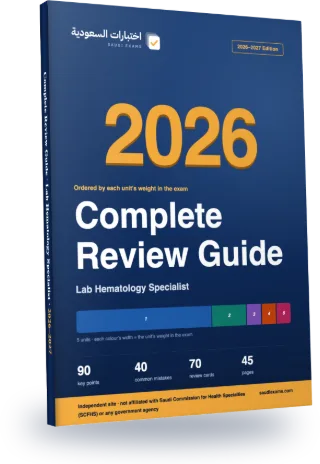 الملخص الشامل 1448 هدية (PDF)مرتب حسب وزن كل وحدة في الاختباراشترِ الآن · 34 ر.سأو 7 أيام بـ 26 ر.س
شاهد كل ما يشمله الوصول
اختبارات تجريبية كاملة مثل الحقيقي، و706 أسئلة مشروحة لتعرف نقاط ضعفك وتتدرّب عليها
- اختبارات تجريبية كاملة بلا حد لتدريب السرعة وقياس أدائك في الاختبار كاملًا
- تدرّب على 10 أسئلة من نقاط ضعفك وابدأ بما يخسرك أكثر
- 706 أسئلة مع شرح سبب صحة أو خطأ كل خيار
- العربية والإنجليزية بوصول واحد
- ملخصات الوحدات وبطاقات المراجعة، ثم أسئلة تختبر فهمك
نتيجة هذا الاختبار جزء من التصنيف المهني لأخصائي المختبرات في تخصص أمراض الدم، ولا تصدر رخصة المزاولة دون التصنيف. وإذا لم تنجح تُمنح محاولات إضافية وفق أنظمة الهيئة وتدفع رسوم التقييم. المصدر آخر تحقق: 2026-11-17